Happier Plants with Passive Hydroponics
Table of Contents
This year I switched some decorative plants and grew some edible plants in hydroponics for the first time. While growing in soil is mainly about gut feeling, hydroponics is a much more analytical approach. If all you know is how to take care of plants grown in soil, it can look intimidating at first and it is easy to get overwhelmed with all the possibilities. In this post I summarize the most important lessons I learned when I was getting started with passive hydroponics.
Disclaimer: I will reference some products that I use, but this is a non-commercial, personal blog and I am not advertising for any specific product. It is just a data point for reference, showing what worked well for me. Wherever possible, I give general recommendations for choosing a suitable, budget-friendly product.
Furthermore, I am also just a beginner in this hobby and just hope that this post can save beginners from some easily avoidable mistakes which I made myself. If you are an actual expert with decades of experience or even have professional background, and you believe that something that follows is criminally wrong or oversimplified, I am open for corrections and suggestions.
What’s “Wrong” With Soil?
Soil is a mix of anorganic matter consisting of minerals and dirt, which is responsible key physical and structural properties, such as water retention and aeration, together with biochemically active material consisting of a whole self-balancing ecosystem of microbial, fungal and other life.
As long as you accept soil as a kind of magical black box which taking care of most needs of your plants, everything is fine. But to me, this feels like forever trying to navigate a room full of obstacles without any light. It is possible, but not satisfying and feels like guesswork.
Mixing good soil out of different ingredients (such as compost, vermiculite, perlite and various other supplements) is a whole art and science of its own. I have tried it with limited success (setting up a small raised bed with different layers, or preparing Mel’s mix), but from these experiences I learned why many people just buy new pre-mixed soil after a season or two of growing, when the old soil is depleted and out of balance.
Taking aside the dark arts of mixing your own soil (which is a purely optional side-quest not every hobby gardener is even interested in), there is nothing really wrong with soil, after all it is the most common substrate in which plants happen to grow naturally. But here are a few reasons why you might want to consider trying something else.
Big Mistakes Are Fatal
It is often said that soil is very forgiving, and it is mostly true - there are many things you can afford not to worry about. If you start with fresh soil suitable for your plant, all you need to take care of is water and light. Depending on the plant, you might need to repot it once or twice into larger pots with more fresh soil, and that’s basically it. Because soil is a living ecosystem, many mistakes smooth out and self-correct over time.
The common advice is that underwatering a plant in soil is better than overwatering it. You can learn to water plants rather easily by following some rules of thumb, such as:
- let the top of the pot visibly dry out before watering again
- only water a pot if soil is dry below the second knuckle of your finger
- weigh a pot before and after watering and learn to assess by weight
This is a problem that simply does not exist in any hydroponics setup. There is no such thing as too much water for a plant - otherwise hydroponics would not work[1]. The problem with overwatering in soil is mainly due to lack of oxygen and beginning of root rot, so basically a pathological shift in the root microbiome.
While overwatering has never been a problem for me after getting a feeling for the kind of plants I am taking care of, for me fertilization is where the pain begins. I almost killed multiple plants because I added too much fertilizer for the plant to handle.
Both overwatering and overfertilizing can be difficult to catch early, and due to the buffering properties of soil can be hard or impossible to fix. Both can cause stress to the plant and even kill it, if you cannot quickly repot it into new soil in order to save it (e.g. because the soil cannot be removed without seriously damaging the root system).
In hydroponics, you can always flush out excess fertilizer once you recognize that there is a problem. Also, if you do it right and monitor the nutrient levels in your hydro setup, this should not be a common problem.
Living (in) Dirt is a Mess
Soil is just fancy living dirt, and because of that repotting plants is always a chore. You usually want to do it outside if you can, and probably not while wearing your best clothes. Usually people simply accept that if you handle plants, both you and the area around you will get dirty. With hydroponic plants, I do not need gloves or any kind of protection - everything is clean and mostly odorless.
Home of All Soil-Borne Pests
Soil contains not only good bacteria and fungi, and it can host various pests that can be hard to get rid of once they establish themselves comfortably, hidden in the soil between the roots of your plant. In hydroponics, your only enemies below the surface are basically just root rot and algae. Both are pretty easy to avoid and control once you learned the basics.
Hydroponics: A Different Way
Hydroponics strips away all the mess and uncontrollable parameters from plant growing. There are different approaches with varying degrees of sophistication and technological dependence. But all flavors of hydroponics have some things in common:
- there is no soil involved, the substrate is inert and not biologically active
- all nutrients are provided to the plant exclusively through the water
Actually, the second statement can be seen as a direct consequence of the first. In soil, there are many biochemical processes going on. Bacteria break down organic matter into a form that plants can directly make use of, or mycorrhiza help plant roots with nutrient uptake. If we now say that our goal is to clean up all this mess and get more control over all relevant parameters, we need to use a microbiologically inert, usually purely mineral substrate. But without all these symbiotic and entangled interactions that happen in the soil ecosystem, the only way for the plant to get digestible nutrients is directly absorbing them from the water with their roots.
This is the reason why you have to make sure to use suitable liquid mineral fertilizers for hydroponics. There are no bacteria around to break down organic fertilizers over time, as it happens in soil. Furthermore, hydroponic fertilizers often contain additional micronutrients which are already available in sufficient amounts without supplementation in soil.
What A Plant Really Needs
In hydroponics, you take full responsibility of providing everything to the plant, and as everybody knows - with great power comes great responsibility.
So what does a plant actually need?
Light
Light requirements vary widely among plants. Many decorative houseplants can thrive even in a pretty dark room or even dislike too much direct sunlight. But most useful (i.e. harvestable) plants will need much more light, you will have a hard time growing veggies indoors without some proper grow lights.
Make sure to get some full-spectrum lights with at least some minimal information about the estimated PPFD. Avoid those cheap and unnatural purple lights - even if something manages to grow, it is still the electromagnetic equivalent of malnourishment.
I’ve had good experiences with Sansi 36W and the FECiDA 25W lights. They do the job well and are pretty easy to integrate in a regular home environment.
Water
Life on Earth needs water, no way around it. In hydroponics, there are different ways how plant roots get access to nutrient-enriched water, for example:
- the Kratky method is based on immersion of roots in the water without any tech
- the deep water culture assumes that water in the reservoir is actively circulated
- the fancy aeroponics approach relies on just spraying roots with water
- most passive hydroponics approaches rely on capillary wicking action
- either by the substrate itself, and/or
- a cotton wick connecting the substrate with a water reservoir
As plants in hydroponics have continuous access to water, you do not have to think about the question when and how much to water your plants. The only thing to worry about is what is currently dissolved in the water, and unlike with soil, you have 100% control over it.
This post is talking about the most common kind of passive hydroponics, which includes all these plants you can often see in office buildings which are not growing in soil. In this case, you typically have some one or two-compartment pot (substrate with the plant and the nutrient solution, either together or spatially separated). The plant is maintained over its whole life cycle by, at least, regularly refilling the water reservoir.
The Kratky method is different from what most people associate with passive hydroponics and can be considered to be a somewhat advanced and niche variety practiced by enthusiasts. In a true Kratky grow the nutrient solution for a whole plant life cycle is filled into a huge water barrel or tank. The plant roots are assumed to grow toward and with the water following the water level down while they are consuming the nutrient solution. In such a scenario you need to setup everything just right to make this work well. Many people call any form of passive hydroponics “Kratky” if roots are placed and grow directly directly in the nutrient solution, which can lead to some confusion.
Substrate
The plant needs to be held in place somewhere and its root network needs space to grow. If not using an approach where the roots just float in the water or air, there are various choices suitable for hydroponics.
Make sure to boil or bake the substrate before using it with new plants to kill any pathogens and sterilize remaining old organic material. Any hydroponics substrate is only sterile before you have used it. Every plant introduces organic material, and old rotting roots from the previous plant can become a serious problem for the next plant, unless you maintain the substrate hygiene between growing cycles.
Coco Coir
For a soil-like experience without the mess, you can use coco coir, fibre made from coconut husks. My rookie mistake was trying to grow plants as if they were in soil while using coco coir. Of course, these poor experiments did not survive. To a plant, coir is pretty much as dead as sand. Coir is not a substitute for soil, but it can serve as soil conditioner to improve soil structure water retention, or as a passive hydroponics substrate.
It is well-suited for starting new seedlings (e.g. as a more sustainable Jiffy substitute) and for plants that generally need a fine soil-like structure and have rather thin roots or very small seeds that do not develop well when put directly into coarse substrate. The main downside of coir is that it is much less reusable than other options. This is because it decays over time and you cannot really clean it due to its flimsy structure.
I would say that it is useful to have some coir around, but not as the main substrate.
Minerals
Pumice and special commercial mixes like Lechuza Pon are commonly used, but you can also grow plants hydroponicaly in pure perlite, vermiculite or sand (all of which are also commonly added to soil mixes in small amounts). Ultimately, the material itself is not important. What matters is how well roots can spread in it and how water and oxygen are absorbed, kept and released due to the grainy or porous structure of the substrate.
LECA
I wish I tried growing in LECA balls earlier. I never cared about it, because it is mostly popular with decorative plants, whereas I always have been far more interested in plants I can eventually eat. Lightweight Extended Clay Aggregate, or just LECA, is an excellent substrate and a very good investment, because they are
- coarse-grained enough to not cause a mess when spilled,
- suitable to grow most kinds of plants, and
- easily and infinitely reusable
You should soak LECA for a day or two in clean, pH-neutral water (replacing it at least once with fresh water) before first use. This cleans it from dirt as well as any residual minerals which otherwise would interfere with your fertilization and watering. Almost everything I learned about LECA is from LECA Addict, this is the best site I know for general practical information about using LECA for passive hydroponics.
Nutrients
The basic nutrients Carbon (C), hydrogen (H) and oxygen (O) are usually available in sufficient amounts from air and water, so once you have a stable water circulation or manual exchange routine in your system, there is no need to worry about those. All other nutrients are provided to plants by mineral fertilizers when growing in hydroponics.
Macronutrients
The main nutrients every plant consumes in large amounts are Nitrogen (N), Phosphorus (P) and Potassium (K). The most common fertilizer mixes a regular person will encounter are NPK fertilizers and all of them will indicate the percentage of the respective nutrients, e.g. 6-3-4 means that it contains 6% molecules providing nitrogen to the plant, 3% for phosphorus and 4% for potassium.
Nitrogen is the main macronutrient needed for vegetative growth. Most general-purpose fertilizers or ones focused on decorative or even edible green plants will usually contain a substantial amount of nitrogen. Phosphorus and potassium play an increasingly central role during fruit formation and development, especially for plants with high nutrient demand, such as vegetables. There are more PK-heavy fertilizers to aid flower and fruit development which are sometimes used instead of or together with an all-rounder fertilizer mix in the later stages of growth.
While it is recommended to use specially labeled hydroponics fertilizers, from my limited experience I can say that other mineral fertilizers also can work perfectly fine. I have grown chives and basil and converted multiple plants like Monstera or Devil’s Ivy to hydroponics feeding them nothing but Compo Liquid Fertilizer for Green Plants and they all thrive on it, even though nowhere on the bottle it says anything about hydroponics. I also have grown tomatoes with Compo Complete both in soil and in hydroponics without any issues, but your mileage may of course vary.
As long as it is a liquid mineral fertilizer, it will probably be okay. Careful though - not every liquid fertilizer is a mineral fertilizer! Liquid organic fertilizers only work in soil, because they assume that the microbial ecosystem in the soil will process the organic compounds.
Calcium (Ca), magnesium (Mg) and sulfur (S) are considered to be secondary macronutrients, i.e. essential for the plant, but needed in smaller amounts than NPK. They are often also part of a balanced general-purpose mineral fertilizers, but can also be bought separately if needed as supplementation.
Unless there are already strong indications of some concrete nutrient deficiency, I would suggest not to buy any fertilizers except for a good universal NPK-centered mix for the kind of plants you want to grow. For example, I only bought a dedicated PK fertilizer once I was pretty sure that a plant needed it (it had obvious PK-related issues in later stages of growth).
Micronutrients
Micronutrients are required for healthy plant development as well, but only in small quantities. These are iron (Fe), boron (B), chlorine (Cl), manganese (Mn), zinc (Zn), copper (Cu), molybdenum (Mo) and nickel (Ni).
My impression is that as a hobby gardener, you should not worry about these and only start to think about them after all other possible issues have been ruled out. Having problems due to micronutrients is of course possible, but rather rare in practice. Unless you mix your own fertilizers from isolated chemicals yourself, you probably will not run into these issues, and if you do, you surely are a professional who knows much more than I do anyway.
Getting Started
What You Need: The Minimum
Aside from the very obvious, here are things you should really have if you want to try hydroponics. I tried to do it with less or differently, it is not worth the trouble. I recommend to get all items on the following list.
- suitable pots (e.g. self-watering pots with separate water reservoir)
- suitable substrate (e.g. LECA clay balls from an arbitrary manufacturer)
- pH and EC meter (just pick a generic multi-sensor device)
- syringes (precise enough to measure 0.5-3 mL)
- suitable fertilizer (liquid, mineral)
- Phosphoric acid (75%)
- Isopropanol (97%)
- Hydrogen peroxide (3%)
I just recently learned that some people swear on hypochloric acid (HClO) in different concentrations for all disinfection purposes. It has shorter shelf life than H2O2, but has the advantage that you apparently can make it cheaply yourself out of water, salt and vinegar. I will probably try to do that at some point, but I am only mentioning this out of completeness and not as a clear recommendation. Unless you plan to do chemistry like that yourself for fun or to save money, I see no reason to use it over H2O2 and isopropanol. Isopropanol is a common cleaning alcohol which can be used for various purposes (sterilization being just one), and hydrogen peroxide does not leave any problematic traces behind, whereas the sodium and chlorine (salt is NaCl, remember?) can cause problems during preparation or usage, unless you know what you are doing.
Update: I tried it, and it actually works! Check out the dedicated post if you are interested in some practical DIY chemistry.
Choose Your Pots Wisely
In a passive hydroponics system you will typically use some kind of self-watering pots. There is a huge variety of such pots, but you can also improvise such a pot by either nesting or stacking two pots.
Make sure that the inner pot has some holes where you can either pull a cotton cord through as a wick, or you rely on water entering directly through small holes to be soaked up by the substrate. I mostly use generic wick-based pots, but also have improvised a few two-compartment pots out of old yoghurt cups and used them for Kratky-style grows. Whatever you do, roots will always find a way to the water sooner or later. It does not matter whether you start with or without a wick. Also, be prepared that the roots will grow through the wick, if you use one.
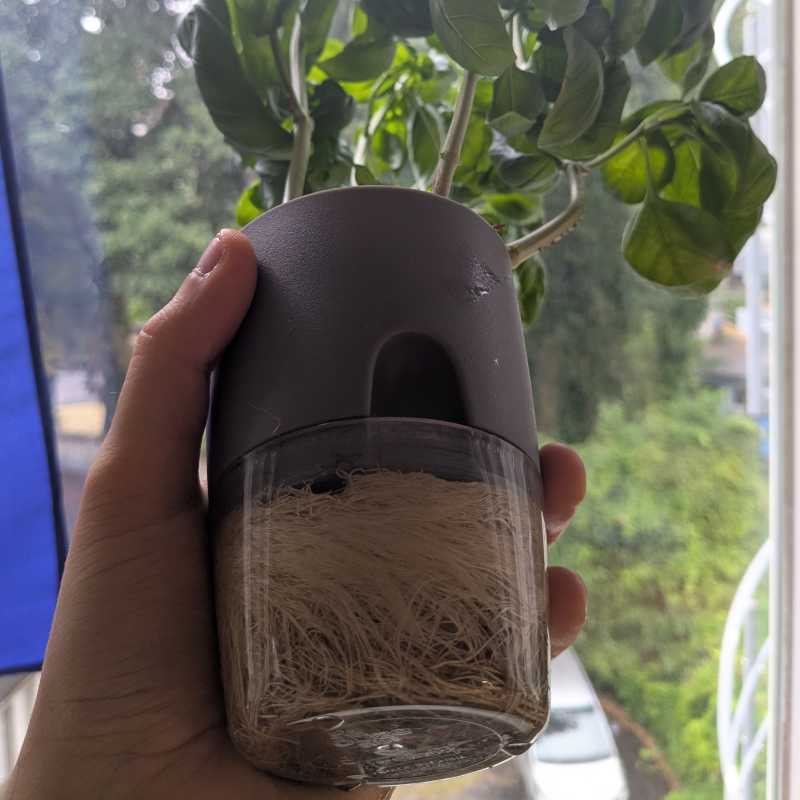
If you want to reuse a cotton wick, make sure to remove all pieces of plant roots you can, boil it and let it stand in hydrogen peroxide for a day or two. You do not want to cause problems for a new plant by leaving in old dead roots of its predecessor. When using an old pot, also make sure to disinfect it properly (e.g. with isopropanol or boiling hot water).
Reservoir Opacity
If you do not want to have problems with green algae, you have to ensure that the water is kept in the dark, full stop. If your reservoir is translucent, sooner or later something will grow there which is not the roots of the plant and it will cause trouble.
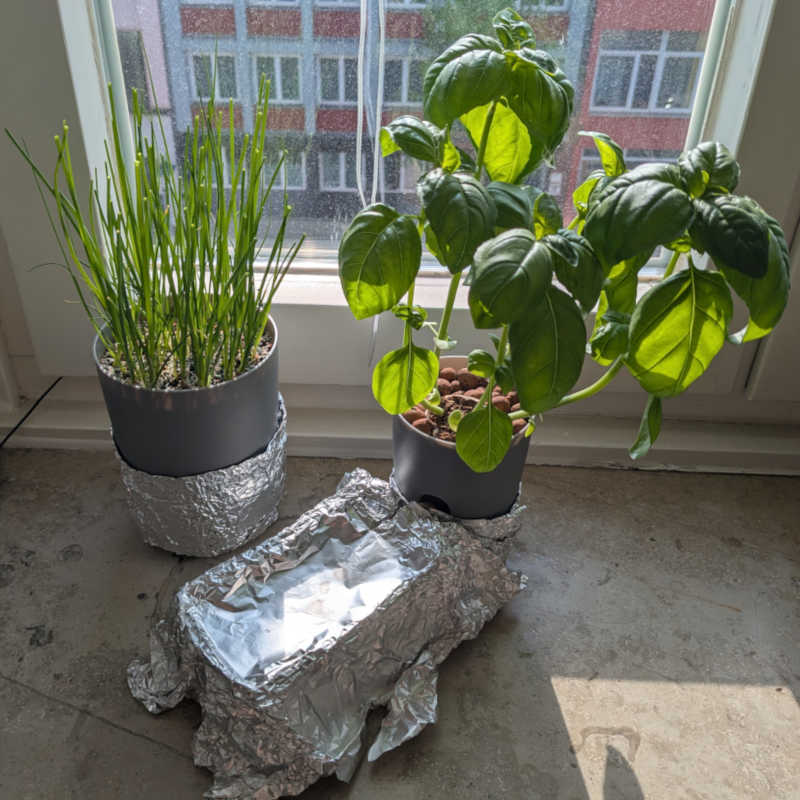
At the same time, it is convenient to have clear or translucent water reservoirs to inspect the roots and water levels easily. I have a bunch of pots with transparent reservoirs and after some fun with algae I always wrap something like aluminum foil around them, but anything you can wrap around to keep light away from the water will do.
Reservoir Shape and Placement
The wicking of water through cotton rope works by basic physics, which also means that the water must overcome gravity while relying on pure capillary action. Flat reservoirs work better with a wick, because vertical distance the water can be transported up passively (i.e., without a pump) is limited, roughly 10-20 cm.
Reservoir Size
If you want to grow non-decorative plants with high water and nutrient throughput, you should make sure that the water reservoir is large enough, ideally almost as large as the connected pot holding the substrate.
If you miscalculated and a plant ends up drinking much more than you have expected, you can put another reservoir on the side and connect the second reservoir with the first one with a wick, like a power bank for a plant which is connected with a cable. This may sound weird, but it works and saved some basil that I grew in a way too small pot.
Prepare the Substrate
Whichever substrate you use, if you already used it with a plant you have to make sure to sterilize it. Depending on the substrate, you can bake it for a while, boil it in hot water or chemically sterilize it using H2O2. I prefer to boil or bake substrate (because it is possible), while I use chemical disinfection for the pots.
I bake LECA balls at around 150°C for at least 30 min in the oven (to make sure the heat distributes well into all balls) or boil it for at least 10 minutes. For other substrates, you have to use common sense or do some research.
If you use coco coir or LECA, you should wash it thoroughly (let it soak for a day or two in clean water, exchange the water at least once) to remove all unwanted trace minerals that could affect your nutrient balance later. Also do this if the substrate is new, it usually will be in an unwashed condition before first use.
It is often recommended to buffer the washed substrate with calcium and magnesium (usually sold as CalMag solutions) and soak it for a while in pH-adjusted water (use your pH down as explained later), that way you level and stabilize the chemical playing field for the plant and avoid unwanted influences. Plants which are prone to CalMag deficits also profit from the CalMag addition, which would be available in sufficient amounts in soil and is not always part of fertilizer solutions.
Introduce a Plant into the System
Once you prepared some suitable substrate as explained above, you want put a plant into it.
From Seeds
If you start from a seed, I suggest using some coir-based starters like these, or some fine-grained mineral substrate of your choice. You want give the delicate seedling roots some opportunities to quickly branch out and develop, and finer substrate provides more structure for the tiny root network to attach to.
Many plants might also grow fine in pure LECA - I tried with basil and it did not mind at all. But to start chives, I added a thin layer of coco on top of LECA. Without the coco, the chives seeds would just have fallen through the LECA balls. Probably plants that need darkness to germinate won’t work well when started in pure LECA, but seeds that are not sensitive to light and become sticky during germination should work fine.
Conversion
You might want to try converting long-living plants from soil to hydroponics. Probably you should not attempt this with any plant that has very fine roots, but the typical contenders with thick and resilient roots such as Monstera or Devil’s Ivy usually survive the process - I converted multiple such plants and they are all doing well.
To convert such a plant, make sure to remove all dirt and soil from the roots. If you cannot wash and carefully shake off the old substrate from the roots without damaging them, you should stop. If you decide to do actually it, make sure that you get the roots as clean as possible.
Cloning
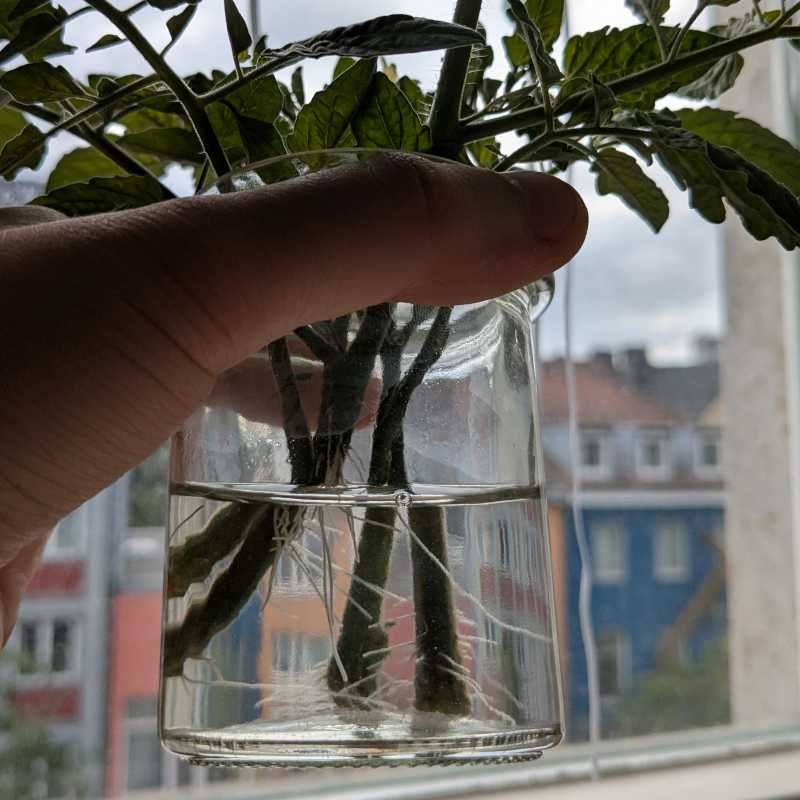
Cloning works exactly like with plants in soil - take a cutting, put it into water and wait, optionally adding some root growth stimulating hormones. Once the roots have a length of 5-10 cm, you can transfer the plant into your hydroponic setup.
Tomatoes are extremely easy to clone - just take one of the sucker branches you normally would trash, and put it into some water instead. Roots will probably sprout in less than a week without any effort from your side. If you grow an indeterminate tomato variety, this is the easiest way to have an infinite tomato plant supply! The advantage is that you can skip the long and stressful seedling stage.
Plant Maintenance
EC and pH
Because in hydroponics you provide nutrients in an unnatural way to the plants, there is less room for error than in soil. However, if you have the right tools, it is actually pretty simple.
There are two values you have to control at all times in your system:
- EC: electronic conductivity (estimation of nutrient concentration)
- pH: acidity of the nutrient solution (affects plant nutrient uptake ability)
pH: Solution Acidity
After researching and comparing various tables of ranges for pH and EC for different plants, it became pretty clear that for the pH value the answer is very simple – if you are not interested in obsessive optimization, just ensure a pH of 6.0 for your final nutrient solution. Most plants have their optimal pH range somewhere between 5 and 7, so with a pH of 6 you provide an acceptable if not even optimal environment for most plants.
Always measure pH after adding the nutrients, minerals from your fertilizer make your solution more acidic. Also note that your tap water is most likely not neutral, so you might start with tap water with pH 8 and after adding the right concentration of fertilizer it might still be at 7. For your plant to be able to make use of the nutrients in an optimal way, you still want to be closer to 6. For this reason you should have a pH-down solution.[2]
The cheapest way to have almost unlimited pH down is to buy concentrated phosphoric acid and dilute it roughly 1:100 with water. Either do the math or figure it out empirically using a pH meter, but you should dilute it so far that one sip of it will roughly lower the pH by 0.1. With such a solution you have great control and you can mix hundreds of liters of pH-down cheaply. I use 2.5mL of concentrated phosphoric acid per 250mL of water.
For pH-down, do not use organic acids like citric acid or acetic acid that you already might have. It might be a seductive idea, but it just does not work properly. I tried it, despite better advice written all over the internet. Do not waste your time, get a proper anorganic acid. Organic acids are partially metabolized by the plants, so the effect on the pH is very unstable. I experimented with citric acid and the results were just disappointing - if you measure just a few days later, the pH will have bounced back up almost all the way to where you started.
If you also ultimately choose to use phosphoric acid, you should note that due to the phosphor it also acts as a fertilizer. You probably have no reason to worry about it too much, unless you use lots of pH down, but if you observe phosphor overdose symptoms in your plant despite supposedly correct use of your fertilizer, you hopefully will remember this as a possible cause.
EC: Electrical Conductivity
Electrical conductivity of water correlates with the amount of dissolved ions in it. It is usually measured in mS and this is the unit I will consistently use. Sometimes devices measure EC in µS, which means that 1500 µS show an EC value of 1.5.
Some people use a value called totally dissolved solids (TDS) that is given in parts per million (ppm), but depending on country there are different conversion factors from TDS to EC. If you only can get the TDS value, make sure to figure out which ppm value equals an EC of 1 mS (= 1000 µS). Usually it is 500 ppm in the US, 700 ppm in Australia and 640 ppm in the rest of the world.
Your tap water usually will have an EC of 0.2-0.3, water from my electric dehumidifier has an EC of around 0.05. While the EC value does not tell you what exactly is in the water, you can assume that most of it is caused by the fertilizer you added, if you start with sufficiently pure tap water.[3]
Measuring the EC of old water before you dispose it can also provide useful information. If the EC is noticeably lower than before, your plant soaked up more ions than it gave back, so you could try to slightly increase the dosage. Conversely, if the EC is higher than before, this could indicate that your plant is over-fertilized (or incorrectly fertilized), so that you should consider reducing the amount of nutrients you provide and increasing the frequency of water replacement.
If the EC goes up on its own like that, it indicates that either you feed the plant too much, or the plant cannot get rid of waste and excess nutrients. In the worst case, this can kill the plant. Even though you can fix this way easier than in soil and even flush out the roots and substrate, still the golden rule remains - it is better to under-fertilize than over-fertilize a plant.
Now the key question is of course: how much to fertilize? Unlike with PH, here the answer is more complicated. If you research the recommended EC values for plants, you can find various tables with different ranges for different kinds of plant and also different ranges for different development stages of the same plant.
There is one important thing to keep in mind: most values you find will be for active hydroponic systems with continuous oxygenation and water circulation. In a passive system, these values can be already way too much for your plants! After some of my plants showed various stress symptoms and I could not understand why, eventually I suspected that I over-fertilized them and after reducing the EC they were able to recover.
After comparing various sketchy tables provided by various sites without any sources, I want to spare you from that and give my own sketchy EC value guideline that should give a reasonable starting point that at least will not kill your plants. I believe that all such tables are to be taken with a grain of salt. Even in the same plant species, preferences can vary due to different genetics and phenotypes, and the values were measured for some plants in some system, not your plants in your system.
Even though I naively hoped that hydroponics would be like an exact science, there is really no way around some trial and error. But once you figure it out for your plants in your system, the results should be pretty reproducible.
Do not fertilize seedlings at all until they have at least the first pair of real leaves (i.e. not counting the first leaf pair they germinated with). Not only can the fertilizer burn the sensitive roots, but it will also slow down development. Roots grow to find nutrients, and if you give too much too fast, there is no motivation for the plant to do the work and grow its root network. But unlike in soil, you must begin fertilizing the plant soon, as the nutrients from the seed are quickly used up, and the substrate itself does not provide any nourishment.
Start very slowly and ramp up the EC in steps of 0.1 over a few weeks, while monitoring the reaction of the plant. The EC should stay below 0.3 for clones and young plants and in early vegetative growth of the plant it should not exceed about half of the maximum amount typically used for an adult plant. This is of course just a rule of thumb. It is difficult to make it more concrete without specifying a plant. Use common sense and scale the EC you use roughly proportionally to the age and total size of the plant.
For decorative plants and leafy greens, increase the EC value up to around 1.0. Some herbs might tolerate or even thrive on EC values up to 1.3. Nutrient-intensive plants such as tomatoes supposedly can be fertilized with EC values going up as high as 3.0 or more, but multiple people agree with my cautiousness and recommend to rather stick with maximum values around 2.0, unless you exactly know what you are doing. A passive hydroponic setup is not a suitable environment for experiments in aggressive EC value maximization, so better be careful.
Regular Maintenance
Once everything is dialed in correctly, all you have to do is to regularly check on your plants and make sure to refill the water reservoir with fresh nutrient solution.
Regardless of how much your plants drink, you should switch out the water at least once every few weeks, because the plant is also getting rid of excess ions. You do not want to let the plant stand in its own trash, while starving and force-feeding it at the same time, do you?
If you have some fruit-bearing metabolically active plant, the EC value can look reasonable, but the nutrient concentrations can still be way off if you never remove old water and only keep adding new solution into the mix. Furthermore, completely replacing the water will also make it more unlikely that some unwanted guests can multiply in the water and attack the roots of your plant.
I am talking from my own painful experience here - do not be lazy and change water regularly! This is the price to pay for using a passive system and not setting up circulation pumps, air stones and whatever else you would need for an active system.
I always wish I had one more hand when switching out water for my hydroponic plants. First I built a contraption from a chair, rope and a lot of knots.
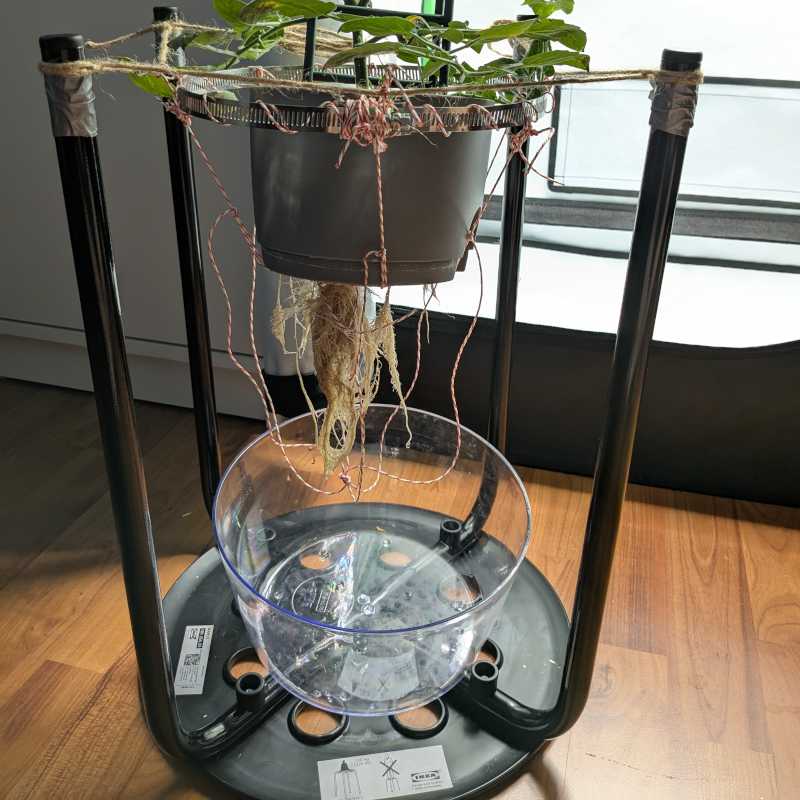
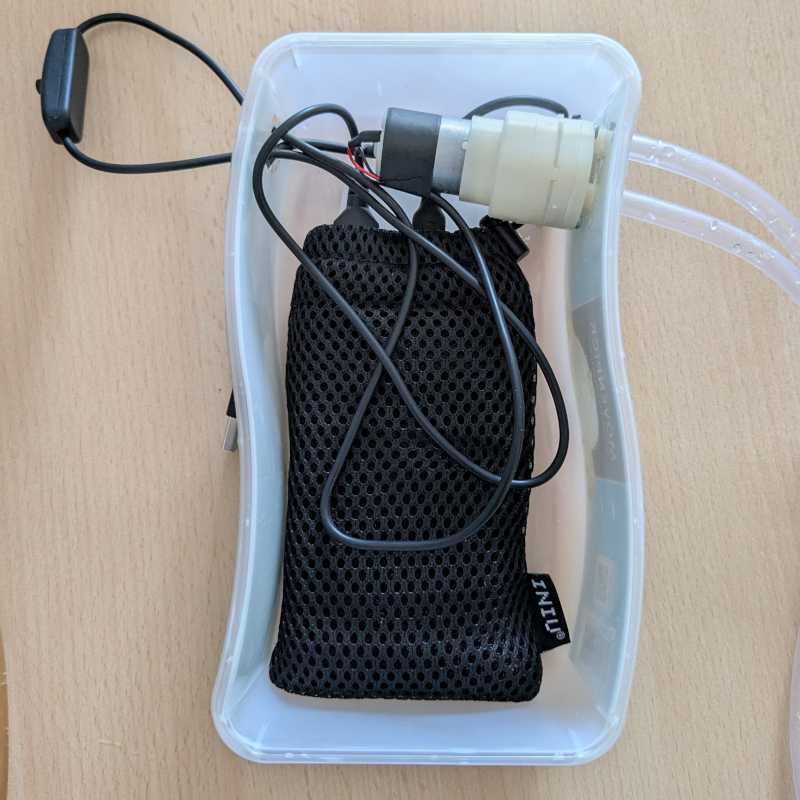
The result is clearly the product of a mind that is still in the honeymoon phase with knotting, another skill I picked up this year. After proudly showing it to the internet, among bewildered reactions I got the suggestion to just get a cheap USB-powered water pump, which was really great advice. You can get such a bare-bones pump for a few Euro from Ali Express. I turned mine into a convenient portable device by equipping it with power bank and putting it in an old ice cream box. Now removing all the old water is a simple and painless process.
Common Problems
Algae and Root Rot
If your water reservoir looks foggy with a greenish tint, green algae are the culprit. They live off the nutrients you add to the water and need light to do photosynthesis. Remove all of the contaminated nutrient solution, Wash the reservoir thoroughly and sterilize it with isopropanol. Carefully rinse the roots, especially if they are already covered by a slimy green layer.
Add a few mL of hydrogen peroxide to your nutrient solution in the next few cycles to prevent algae regrowth and make sure you keep the water in the dark from now on. Make sure that you do not accidentally treat your plant with isopropanol, it is very aggressive and you only should only use it to clean surfaces that will not contact your plant before you thoroughly rinse everything with water.
To disinfect parts of the plant, you should use a low-concentrated hydrogen peroxide solution. It can also be used for pots and other utilities, but then you should soak them in the hydrogen peroxide for a while, up to half an hour or longer, if you have the time.
Shelf life of hydrogen peroxide is limited (at most 1 year), so getting highly concentrated solution and mix it down, like you can do with phosphoric acid, does not make sense in this case. Food-grade 3% solution is effective enough while being very safe for the plant. For everything else, use the highly concentrated isopropanol.
If the roots of the plant become soft, brown and slimy, root rot is the issue. Root rot are fungi that live off the roots and kill them. Healthy roots are usually plain white, at most with a yellowish or light brown tint that can be either due to your fertilizer or because the plant was transplanted from dirty soil. If you see abnormal or decomposing roots, you have to remove them as soon as possible. If you do not, the rest of the roots can get infected.
You should let the plant roots sit in in 5-10 mL hydrogen peroxide for 5-10 minutes. As with algae, sterilize the water reservoir with isopropanol, clean the roots and keep adding around 1-2mL hydrogen peroxide to the nutrient solution at least for a while when changing the water.
Root rot thrives in stale, oxygen-depleted and over-fertilized water. Such an environment creates stress for the plant roots and at the same time gives root rot the chance to get a foothold. The best way to avoid it is to ensure that you switch the water out regularly and that both pH and EC are in a viable range for your plant.
Especially if you are lazy with replacing water like me, then whenever you finally do, you can always add just a little bit of H2O2 to your nutrient solution to prevent root issues. I know this is a controversial piece of advice, but I had no problems ever since I started doing that.
Aphids, thrips and other troublemakers
There are many bugs and plant diseases that can wreak havoc and live on the plant leaves most of the time, so they do not care much about your substrate and will also happily populate your hydroponic plants.
While it was not successful when I tried it, you can try to use biological warfare, such as some species of predatory mites. Just make sure that you do not pick species which require soil to live and multiply.
I had very good experiences with neem oil, which inhibits the reproductive system of various bugs and gives the leaves a temporary shiny protective coating. Follow the instructions of neem oil application correctly. Even though the oil is of natural origin, it can damage the leaves of the plant if you overdo it. Wait for about a week before you harvest and eat parts of plants that you treated with neem oil.
To avoid any problematic fungi like mildew or botrytis, make sure that there is enough air circulation between the leaves. Leaves or fruit should not touch and there should not be too dense areas in the plant canopy. Stale, humid air will make water condense on parts of the plant and the microscopic condensation droplets are where fungi can set root. Especially in the wet and cold seasons of the year, an air dehumidifier (chemical or electric) is a good investment, depending on the area where you live. Keep humidity below 65% at all times. To ensure sufficient air circulation and to avoid water condensation on plant surfaces, you can use a regular oscillating fan that is pointed at your plants.
Nutrient imbalances
Some plants are not picky about the nutrients you give them, but some are really sensitive. Check that the EC and pH values you set for the plant are adequate for the kind of plant and its development stage. Make sure that you switch out water regularly (did I mention this before?) and also check EC and pH values in the disposed water. If the values are very different from what you put in, the nutrient concentration could be suboptimal or you need to renew the solution more often. If you are certain that these basic parameters are dialed in correctly, but your plant still has issues, you will have to diagnose it. However, this is nothing specific to hydroponics and a skill I am still learning myself.
If leaves, especially new ones, are pale in color but there are no special spots or structures on them, it might point to a nitrogen deficiency. If instead leaves are unusually dark green, it could be a nitrogen overdose. If flowers and fruit do not grow or even die off, it probably is an issue with potassium or phosphorus. These are just the simplest rules of thumb that I have picked up, and I do not dare to give more advice on this advanced topic. Reading symptoms off the plant leaves and growth abnormalities and interpreting them correctly is a challenging skill to acquire, maybe the most difficult one in plant growing, but also one of the most useful.
Conclusion
Is growing plants hydroponically easier than in soil? Probably not, but it is also not more difficult - as you can see, all a beginner needs to know can be said in a single blog post. For me at least, growing plants with passive hydroponics is a lot more fun, because you have more tools at your disposal than just gut feeling and experience.
There are more useful variables you can measure, tweak and fix, and there are less confusing variables which you can neither know or influence. You can check whether the roots of the plant are healthy and happy, which is impossible in soil. There are less pests and other issues which often remain hidden in soil, it’s just you and your plant.
Is this way of growing plants for everyone? Probably not. Like many things in life, it is a matter of preference. But I think that everyone interested in plants should at least try and see whether they might enjoy this alternative approach.
Happy growing!
-
Of course, there are exceptions. For example, cactii are not well-suited for hydroponics. I tried to find experience reports, but it seems to be such an obviously stupid idea that almost nobody even tries to do it. The general consensus seems to be: even if it works, it is torturing the plant. Roots of cactii are used to very different conditions from most other plants, but they are also not plants you find in a soil-grounded area. Just like some plants do not thrive soil, some plants also do not thrive in hydroponics. ↩
-
If your tap water is more on the acidic side or your nutrients pull the pH down too far, you might need to go in the other direction. There are also pH-up solutions you can buy or dilute yourself from some suitable chemical you can get cheaply. I did not research pH-up though, simply because I did not need it. ↩
-
Some people believe that you need to have a reverse osmosis system. I think this is overkill for most users, unless the cleanest water you can use has an EC significantly above 0.3 and could noticeably affect your EC measurements or interact with the fertilizer in unpredictable ways. ↩